

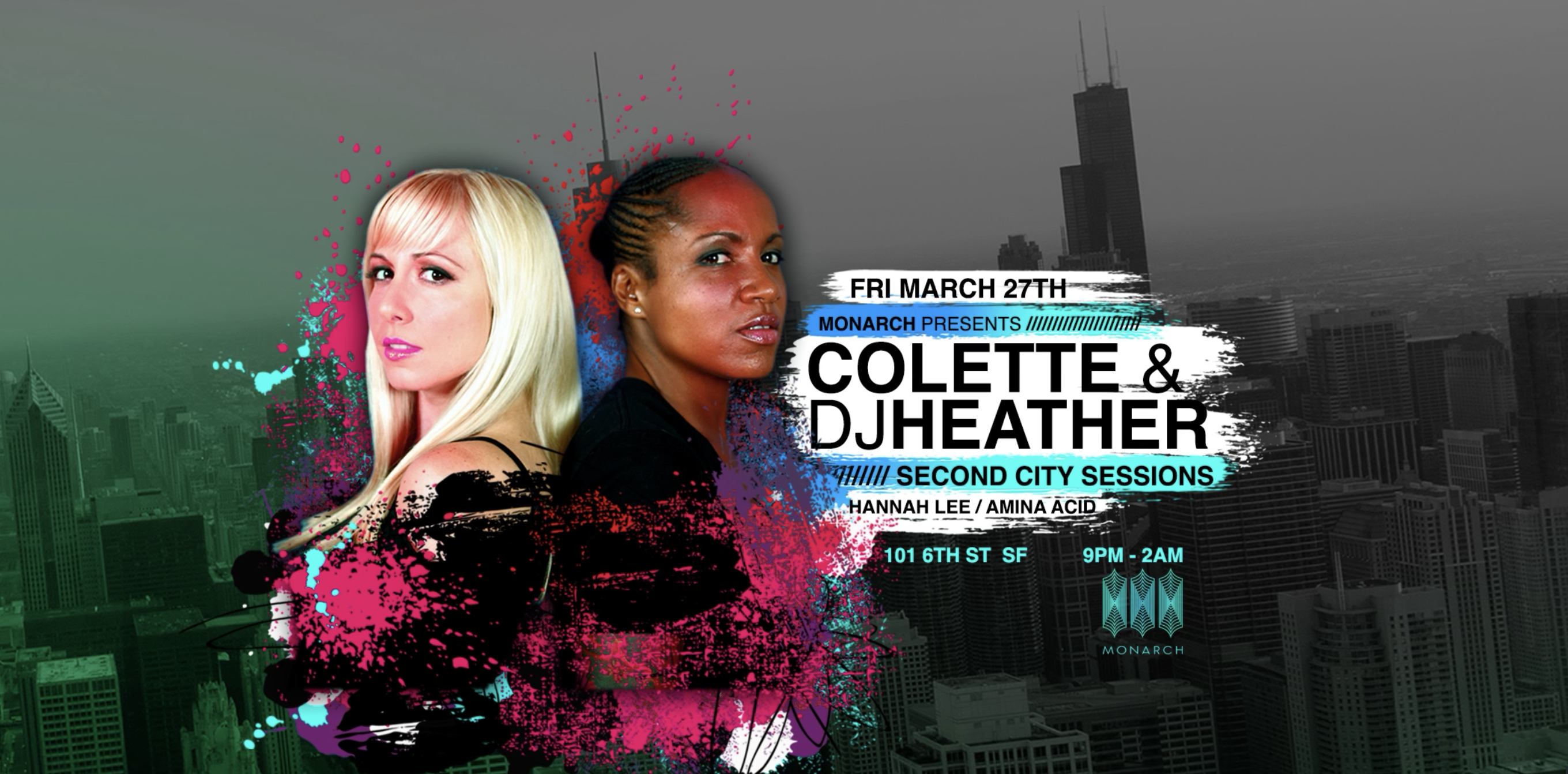
Colette & DJ Heather | Hannah Lee| Amina Acid
Monarch
∙
San Francisco

Friday, March 27 at 9 pm PDT
EDM
Serves Food
Lounge
Nightclub
House
Bar




Colette & DJ Heather | Hannah Lee| Amina Acid
Monarch
∙
San Francisco
Friday, March 27 at 9 pm PDT
EDM
Serves Food
Lounge
Nightclub
House
Bar


Details

Artists

Description
Colette and DJ Heather, The Queens of House are taking over Monarch!
DJ Colette
DJ, producer, vocalist – Colette has grown from an integral part of the Chicago underground into a breakout musical triple-threat releasing her most accomplished and fully realized artistic statement to date. Combining the tunefulness of classic pop so..DJ, producer, vocalist – Colette has grown from an integral part of the Chicago underground into a breakout musical triple-threat releasing her most accomplished and fully realized artistic statement to date. Combining the tunefulness of classic pop songs with the thump of classic house of her hometown, the album ventures into new sonic territory for Colette, from intimate bedroom beats to stadium-shaking dance anthems. When the Music’s Loud is the sound of an artist at the peak of her powers.
“I grew up listening to pop in the ‘80s, and as I got older, I was really deep into the ‘90s house scene,” says COLETTE when talking about the shockingly panoramic sounds found on her third studio full-length, When the Music’s Loud (Candy Talk Records). “For me, these two elements are always sort of married. This album is my way of bringing those sounds together as one.”
“We started crafting this record, and it wasn’t until we wrote ‘Electricity’ that we figured out what we really wanted to do,” Colette explains of the new album’s origins. “Even though it’s so far away from what I normally do, the tone of it was where we clicked,” referencing her longtime songwriting partner Tim K. “It was different, but it still sounded familiar, and it was exciting to us.”
The album is awash with the robotic sounds of the vocoder, famously used to legendary effect by such pioneers as Giorgio Moroder and Electric Light Orchestra, but here is applied by Colette in her own inimitable fashion.
“We put them in as slight undertones in some songs, so you might not even notice that they’re there,” she explains. “The first time I ever saw someone use a vocoder was when I was 8. My friend’s parents were in a band, and they had one of those keyboards with the hose attachment that you would sing into for the vocoder effect. From that moment on, I always thought they were cool. That was a theme as well for us on this album: We wanted to take these old elements and use them in a modern way.”
"We were influenced by Kraftwerk, Africa Bambaataa, Adonis and Romanthony,” Colette reveals. “‘80’s futurism was the inspiration and launch pad for this album.”
Lyrically, When the Music’s Loud finds Colette looking back at her 20 years of making music and clearly seeing what was really important on the journey from then to now.
“We were thinking about the countless stories from the ongoing travels of life. There are some love stories in there, but it’s more about friendship and the people around you as you grow. I’ve had the same group of friends for 20 years, and we were all in this environment together. We’re family.”
Those enduring Chicago connections are most apparent with the song “Hotwire,” which rides over the instrumental beat of acid house legend Adonis’ 1986 underground club classic, “No Way Back.”
“I’ve loved acid bass lines since I was a child. They always add a lot of flavor,” Colette says. “To be able to have that sound and Adonis’ music on a record is really special. It feels like home.”
While Colette has evolved into a seasoned songwriter and producer, she’s never far from the DJ decks, perpetually on tour traveling the globe spinning crowd-pleasing and party rocking sets from Los Angeles to Tokyo.
“We’re at an interesting place in 2013,” she surmises. “Dance music is so popular in America right now, but it’s for the commercial aspect of the sound. For an underground DJ like me, I find myself spinning for crowds that are made up of people who’ve been with me for the last 15 years right next to these new, fresh faces still getting into the music. It’s definitely a jugging act making it work for everyone, including myself, but it’s a challenge I still love and look forward to every night I’m in the club. It’s fun, but there’s a lot of thought that goes into what I’m playing.”
The music, the memories, the people, the places — it’s a journey that Colette has shared with the world around her for as long as she’s been able, cultivating a large and loyal fan base that’s always eager to support the sounds she brings to light.
“Getting to play music is everything to me,” she says. “2013 and 2014 will be all about sharing this record. I will always play versions of my other songs, but When the Music’s Loud is something I’m really excited about. I’m hopeful that people will like it and want to continue on this journey with me.”
DJ Heather
Widely regarded as one of the premier selectors in the nation, this Brooklyn born Chicagoan demonstrates her skills and sharp deck acumen for the massives throughout Chicago and the world at large with verve and undeniable talent.
In the past few years the Chicago house community has produced a number of innovative and distinct djs trained in the art of transforming tranquil dance floors into spaces of sheer bedlam and bliss. Derrick Carter, Diz, Mark Farina and Sneak stand at the forefront of the nouveau jock barrage born and bred in the underground gatherings which flourish there. Their committed visions of undiluted musical appreciation, interactive communication, improvisation and basic integrity has brought greater attention to all the city's great djs including the genre busting DJ Heather. Widely regarded as one of the premier selectors in the nation, this Brooklyn born Chicagoan demonstrates her skills and sharp deck acumen for the massives throughout Chicago and the world at large with verve and undeniable talent.
At the urging of a friend, after hearing an unmixed compilation tape of her's, Heather started out at the Artful Dodger. A neighborhood pub with a cramped moist dance area situated in the rear. Being such a music lover djaying was a natural progression. I would ask some friends to come by. It was my chance to share my favorite records and have a few drinks " I was not really mixing but learning how to play records, programming 101." "I was responsible for five hours of music every Saturday night. Eventually I got into the technical aspect of djaying, watching other djs play and learning by example. Finally I was able to get turntables and began practicing six hours a day if I was able. The first time I mixed two records it was like discovering a new secret language" "At that stage it was truly a hobby, something I did on weekends. I always think of the dj thing as the happy accident. Maybe because I came into it at a stage when it wasn't considered a superstar thing to do. I was the only dj in a circle of photographers, actors, designers and so on." At that time she was also working for local record labels and garnering experience about the industry. One gig lead to another and the hobby soon manifested itself into a full time pursuit. For five years she earned her chops by playing an urgent mix of hip hop, house, jazz, soul, RnB, disco classics, rare groove and all manner of off-center beats relevant to the stew she was brewing. At the Dodger she fully developed her versatility and philosophy as an entertainer.
During her fourth year at the Dodger, she began what would be a three year residency at Red Dog. A Wednesday night gig dedicated to downtempo beats, hip hop, rare groove and disco. "At Red Dog I was able to fully develop as a dj and hone my skills." At that same time she began a short but invaluable stint at world famous Gramaphone Records. Many of Chicago's well known djs have made a stop there; Sneak, Mark Farina, Derrick Carter, Terry Mullan, Gemini, Colette and Miles Maeda to name a few." That place was my resource center. I was hired to be the hip hop buyer. I would also use their phone lines, fax machines, FedEx and ups accounts to the fullest extent. I used the store to make contacts, ship demos/press kits and sell my own mixed material. Three years later, once bookings got in the way of covering shifts, I had to say good bye. I felt like I had graduated Gramaphone Tech. It was such an invaluable experience." Primarily known in the Chicago dance community as a "hip hop" dj she began a shift in the material she played. "It was never a conscious effort to play one genre more than another. I've always been interested in all forms of music. The demand for me to play house seemed to increase after each gig. Over time one just gave way to another. Gone but not forgotten"


