

Dry Cleaning
Meow Wolf
∙
Denver

Wednesday, May 13 at 7 pm MDT
Concert Venue





Dry Cleaning
Meow Wolf
∙
Denver
Wednesday, May 13 at 7 pm MDT
Concert Venue
Entry options


Details

Artists

Description
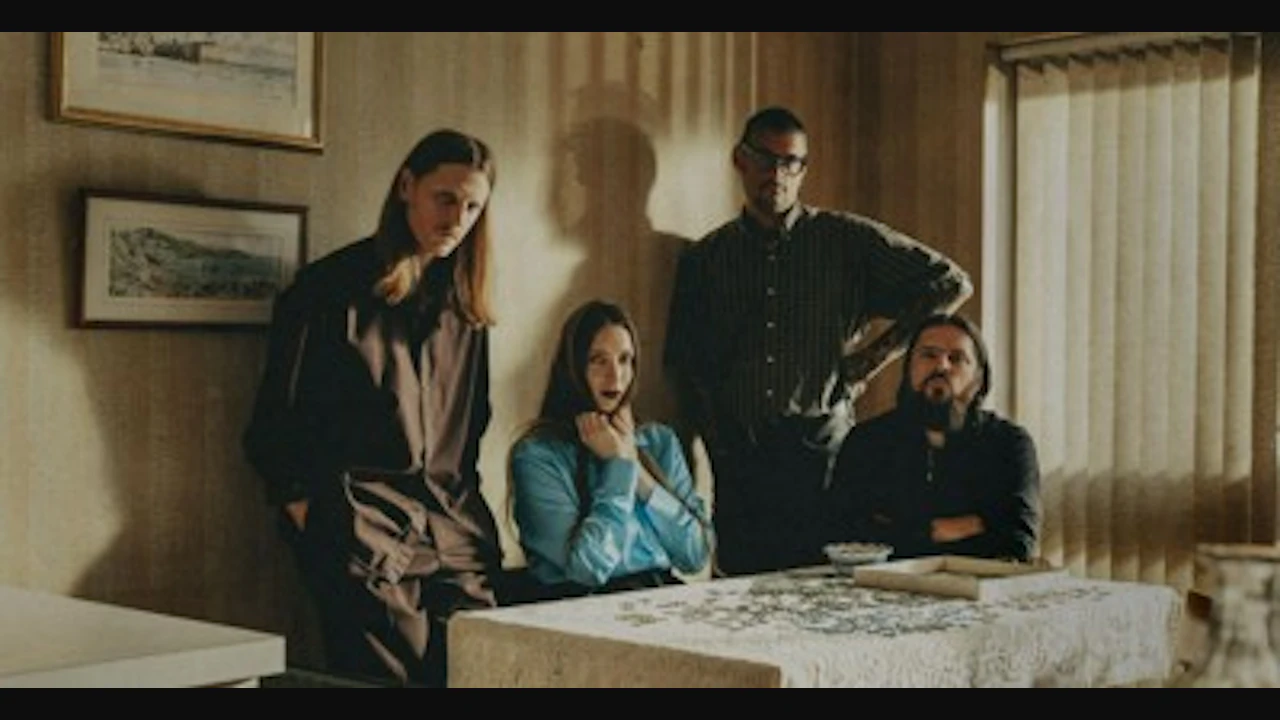
Secret Love is the finest expression yet of the profound friendships that created Dry Cleaning. Here, frontperson Florence Shaw, guitarist Tom Dowse, drummer Nick Buxton and bassist Lewis Maynard take their place in rock’s avant garde, catalysing the Reaganite paranoia of early 80s US punk and hardcore with the dry strut of Keith Richards, stoner rock, dystopian degradation, playful no wave and pastoral fingerpicking, while Florence’s delivery, meticulously calibrated to her bandmates’ soundscapes, asserts her in a lineage of spoken-word artists stretching from Laurie Anderson to Life Without Buildings’ Sue Tompkins. Producer Cate Le Bon likens the impression of listening to walking through a city; these 11 songs might also arrive like distinct images in a gallery. The record started life in Peckham rehearsal spaces, the south London four-piece writing, playing and responding to each other in the room, the instrumentalists egging each other on as Florence drew from her collection of postcards and found materials: in Dry Cleaning, music and lyrics form an inseparable, generative whole. Then they bundled their demos in a suitcase and took them to musical friends with strong palettes to test and twist them. Secret Love evolved through affirming sessions at Jeff Tweedy’s Chicago studio the Loft and explosive ones with Gilla Band’s Alan Duggan and Daniel Fox in Dublin, taking advantage of the sonic particulars of each space, and finally with Cate in the Loire Valley. Some acts would fear being subsumed by these other musical iconoclasts. Dry Cleaning wanted to push themselves harder than they ever had before. “We’re very confident about our identity,” says Florence. “It doesn’t seem to be possible to break it down.” The opposite: Secret Love is a singular, career-defining statement, coming after debut New Long Leg (2021) and Stumpwork (2022). They push the cheeky no wave of compulsively catchy lead single Hit My Head All Day somewhere totally unexpected, powered by pistons of breathy synths and magnificent cresting arcs of guitar. Cruise Ship Designer is a classic Dry Cleaning pop song in the vein of Gary Ashby, sung from the perspective of a nautical entrepreneur who has deluded himself that his work serves society. There is unprecedented darkness in Blood, a lurch between forlorn chill and desperate alarm that confronts the normalisation of witnessing atrocities in Gaza, the West Bank and Ukraine online, and the British government’s callous, capitalist attitude to war. Amid these disingenuous actors, Florence turns over questions of trust, and volunteers more of herself than ever before, a profound gesture of connection. She finds Secret Love “quite sad and dark,” she says, but feels good about the honesty of that reflection. “I really love confessional things,” she says. “It always makes me feel calm when people are sharing hidden stuff. I hate when you get a sense that there’s stuff people aren’t saying.” The more introspective songs search for coherence between interior and exterior: the panicked longing for connection in spite of the certainty that people are repulsed by you in the Pentangle-influenced Let Me Grow and You’ll See the Fruit; the warring frustration, lust and foolishness in the bristling crucible of Rocks, Dry Cleaning’s most teeth-gritting rager. My Soul / Half Pint is the goofiest expression of this tension, exploring Florence’s love of tidying – organising to a satisfying internal logic – but hatred of cleaning, a tedious social good. The album affirms the power of coherence in love. The celestial Secret Love (Concealed in a Drawing of a Boy) preserves an unspoken crush for eternity. The Cute Things is a daydreamy swirl about the beauty of self-sacrifice in true relationships; the barely adorned pulse of I Need You uses the characteristically off-kilter image of being fired by Donald Trump on The Apprentice as an analogue to the beautifully deranged pressure of pinning all your hopes on one partner: “The finger coming down: you.” It’s no mistake that Secret Love ends on a similarly optimistic note to Stumpwork. Icebergs, the closing track to their second album, advised: “Stay interested in the world around you / Keep the curiosity of a child if you can.” Here, the song Joy offers “don’t give up on being sweet” in the face of troubling mansophere cults. It can be hard not to feel overwhelmed by the lurid grotesques beaming dogma from your FYP page and wonder if you shouldn’t give up and join them. But Secret Love is a reminder to find the people you can go floppy with; a transmission of the band’s love and trust in one another that listeners might share in, too.
Hotline TNT Will Anderson needed to call a timeout. It was October 2024, in the studio of modern D.I.Y. hero Amos Pitsch, clear across Wisconsin from the small town where Anderson was raised. As he has done for every increasingly absorbing Hotline TNT album, Anderson arrived at the studio with eight, maybe nine demos he liked, leaving himself room not only to expand their sound but to write a few tracks in the room, too. But this time, and for the first time, the quartet that had toured for the last 10 months as Hotline TNT had come with Anderson, somewhat unexpectedly. He had intended to make one more album his way—holing up with a producer and building songs piece by piece, as he’d done for the 2023 breakthrough Cartwheel—before making Hotline TNT a full-band affair in the future. But guitarist Lucky Hunter, bassist Haylen Trammel, and drummer Mike Ralston wanted in. Anderson relented. As they cycled repeatedly through one of Anderson’s demos, they couldn’t unlock the way to play it, the power and pattern that Hunter’s and Anderson’s guitars needed to share. When Hunter began playing a part that had nothing to do with that song, Anderson dipped, heading upstairs with his guitar in a spell of mild pique and fatigue. When he emerged a few hours later, he’d written “The Scene,” a spiraling-and-stomping new song about wanting someone to throw a tantrum on your behalf. The rest of Hotline TNT, meanwhile, had written a lunging and moody instrumental, guitars pulled as tightly as razor wire against Motorik drums. Anderson resisted at first but then helped finish “Break Right.” Both songs are now tentpoles of Raspberry Moon, the most sweeping and compelling Hotline TNT album to date and, crucially, the first built by a full band. Oh, the other song they couldn’t get right? No one remembers its name. That moment is but one element of the vulnerability and romance that funneled into Raspberry Moon, a generationally great statement of youthful wistfulness and very adult growth that also happens to be very charming and sometimes funny. Not only did Anderson cement his touring band in the studio, but he also wrote the most direct love songs of his life, winning testaments to a relationship that has seemed to change his perspective on sweetness, sincerity, life itself. And when the quartet finished tracking with Pitsch, Anderson essentially handed him the tracks and asked him to play along, adding harmonies, keyboards, and percussion wherever he felt it worked. (Pitsch is credited as the fifth member here—so much for a solo project, huh?) Some of these 11 songs still deal with the sting of regret, of being left or leaving, as Hotline TNT always has. But this is a record animated by a sense of newness and possibility, of pushing back against the global sense that curtains are closing to make room in your own life for new friends. It is perfect music for looking forward, no matter how fucked the past may feel. Two months before Hotline TNT stopped at Pitsch’s Crutch of Memory between tour dates, Anderson thought another version of his touring band had reached its ignominious end. They were three songs into a set at Poland’s Off Festival when, in front of a few thousand people, Hunter’s knee rotated 180 degrees, fracturing his kneecap and ripping the sinew. Paramedics cleared the room and carted him to a hospital. The band assumed it was just another unlucky break, like the meningitis that forced Anderson to lay in a cot in the back of a van during an early Cartwheel tour or the litany of lineup squabbles and fractures during the band’s first seven years. They had made it most of a year, since Hunter enlisted just ahead of a pivotal winter tour with Wednesday. But how could they go on? As Hunter steadily reckoned with the pain, he made the surprising decision to stay on the road, to play the rest of the dates sitting down. He could go home and make his girlfriend miserable with his grievances, or he could suffer through in order to play songs he loved. It would make for an impressive story, at least. For Anderson, it galvanized a burgeoning if occasionally difficult belief: Hotline TNT was now a band, and this was the band. The benefits are self-evident on Raspberry Moon—the most texturally rich and energetically nuanced album Hotline TNT has ever made—from start to middle to finish. Opener “Was I Wrong” slides in on a web of seasick guitars, acoustic and electric pinballing off one another as Anderson wonders how a past relationship collapsed. The band slams in and helps him push those worries off, to realize that every burden can’t be his to hold. What’s most remarkable, though, is the way a half-dozen discrete hooks emerge in just more than three minutes. There may be even more during “Julia’s War,” an anthem of nascent affection where a simple and wordless chorus of “na na na nah” paints a horizon of possibility. The guitars are perfectly warm and sharp, cutting into you but simultaneously pulling you into the song. Anderson’s old self-doubt creeps back in during closer “Where U Been?,” but the rest of Hotline TNT buoys him, pushing him upward and toward whatever comes next. Anderson has never written a love song as real and candid as “Candle,” an open-hearted marvel about leaping into that blissful void where butterflies float through your whole body. He acknowledges his past and then turns away from it, propelled by a band that sounds eager for him to find something satisfying: “They don’t hold a candle to you/Nothing more than I can prove,” he sings, surrendering the control of logic and just giving in to whatever may come. This act of submission is an arrival, captured again in the slowcore beauty “Lawnmower” and the long-distance hug of “If Time Flies.” You could find yourself cheering for Anderson’s next steps by the time Raspberry Moon ends; at the very least, you will find yourself swept inside these songs. Musical auteurs have been a feature of rock ’n’ roll since its very early days—folks who could imagine a sound and the path to it, largely alone. Something akin to Moore’s Law has made it easier to become exactly that during the subsequent decades, since studios with solid gear are now as accessible as a bedroom. It is increasingly convenient to be solo. The real work, though, is to abandon the ego and singular devotion to your absolute vision and make something better with the people you trust. Hotline TNT has done exactly that on Raspberry Moon, an album where Will Anderson gives himself space to fall in love with the world around him and sing as much in songs so loaded with hooks you’ll need to choose which ones to hum at any given moment. “My insecurity, baby,” he repeats during “Dance the Night Away,” a tender devotional lit by the guitars, drums, and bass of his bandmates and bejeweled by Pitsch’s perfect piano line. Perhaps it’s the sound of him waving goodbye to it, of calling time-in once and for all.


